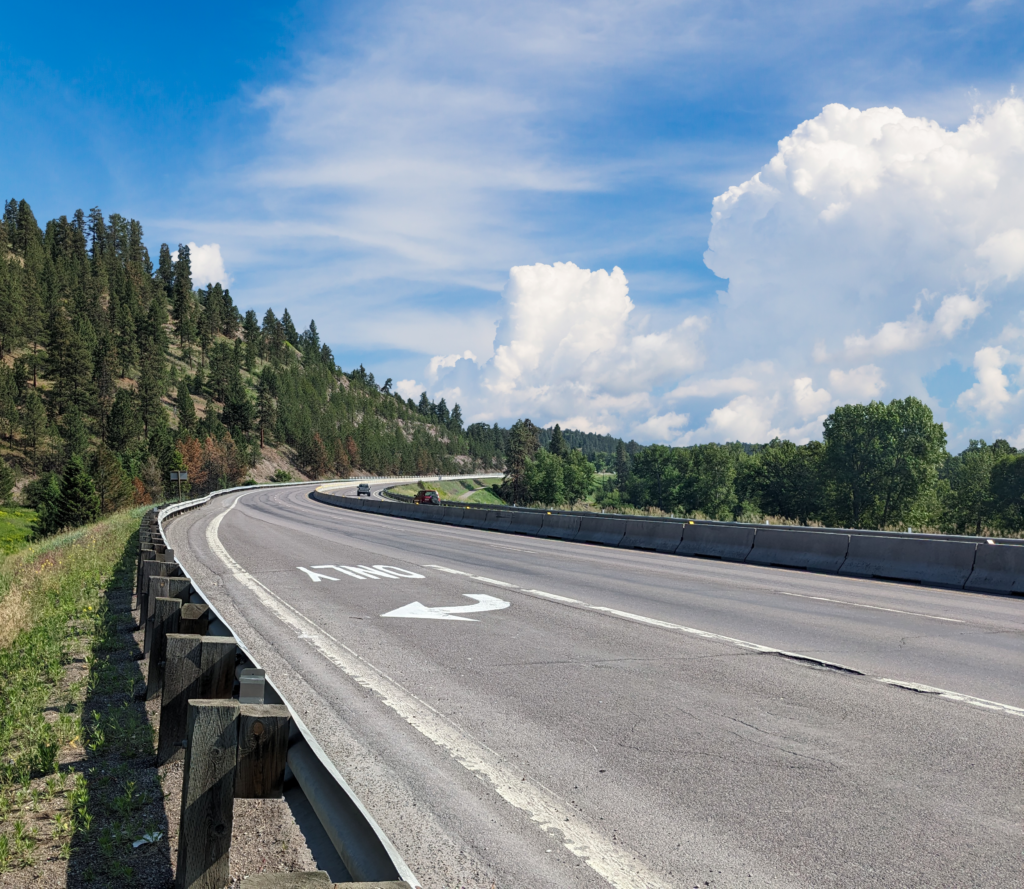
The US 93 study corridor from Florence to Missoula is used by commuters, residents, and regional travelers, and commercial freight haulers, with access to adjacent residences, businesses, and agricultural lands. Traffic volumes have outpaced projections as the area has continued to develop. This pressure has contributed to congestion, reduced travel times, increased user conflicts, and ongoing safety concerns, especially at uncontrolled intersections within the corridor and during peak travel times. The intent of the US 93 Missoula-Florence Study is to evaluate safety and operational conditions within the corridor and identify comprehensive, data-driven, and forward-looking solutions to address concerns over the long term given environmental resources, right-of-way needs, access control, maintenance considerations, and other potential constraints.
Key Project Elements
- Integration of past planning into more detailed engineering analyses
- Constrained corridor through environmentally sensitive areas
- Extensive coordination with resource agencies and key stakeholders
- Evaluation of geotechnical, hydraulics, wetlands, cultural, and right-of-way
- Roadmap for implementation of future improvements
Project Description
The US 93 corridor between Missoula and Florence serves as a vital access route for adjacent residences, businesses, agricultural lands, and commuters traveling between smaller Bitterroot Valley communities and the City of Missoula, while also accommodating significant commercial freight traffic. This growth has resulted in safety concerns, user conflicts, increased traffic congestion, and longer travel times.
The study conducted wide-ranging analyses of the physical roadway, safety, traffic operations, and environmental features to establish baseline conditions for the corridor. This step was important to understand key issues, needs, and constraints influencing future improvements.
To address these issues, the study identified and evaluated a range of potential options to improve safety and traffic flow on US 93 while enabling feasible implementation and minimizing impacts to adjacent landowners, the environment, and the traveling public. This effort attempted to best address the primary areas of concern identified through public and stakeholder outreach, discussions with the MDT study team, review of past and current planning documents, and technical analysis of physical features, traffic, safety, and environmental conditions while also meeting the purpose and need of the highway. A sequential approach was used to identify, screen, and select the preferred corridor configuration with continuous public feedback integrated into the process.
An optimized corridor configuration was identified, integrating the most practical and effective elements from corridor concepts and intersection control alternatives. This process involved strategically blending design alternatives that were found to best meet the study’s goals and objectives. The aim was to develop a comprehensive and feasible recommendation for the corridor that balances the overwhelming need for improved safety with efficient highway operations, while minimizing implementation costs, construction timeframes, and impacts.
Project Details
Client
Montana Department of Transportation
Location
Missoula and Ravalli Counties, Montana